
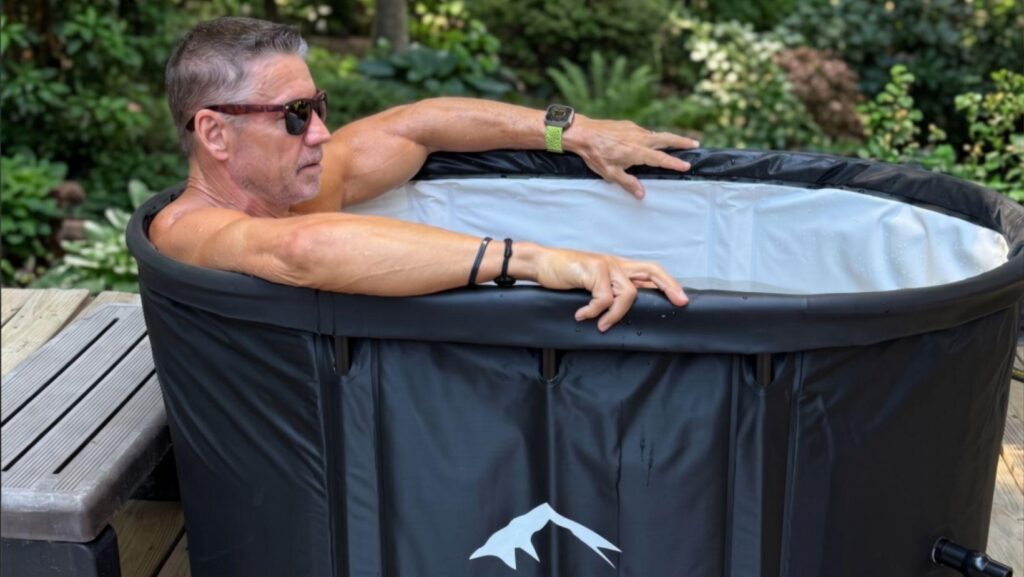
Walk into any high-performance gym or private training facility early in the morning, and you will quickly notice a strange behavioral correlation among the people lining up for the cold plunge. They are rarely the individuals who skip their accessory work when the training session gets long. They are almost never the ones who abandon their nutrition plans over a chaotic weekend, and their sleep schedules operate with deterministic precision.
Initially, it is tempting to chalk this up to a classic case of selection bias. The common assumption is that individuals who are already hyper-disciplined are naturally drawn to extreme wellness practices like freezing water immersion. But tracking behavioral data over time reveals a completely different vector.
Regular cold plungers do not just maintain consistency within the ice; their adherence to completely unrelated health goals—like gym attendance and dietary compliance—surges after they make cold exposure a daily ritual. This raises a fundamental neurobiological question: Is cold exposure simply a filter for naturally disciplined people, or is the act of stepping into freezing water actively training a neurological mechanism that bleeds into every other hard choice we make?
If we look past the standard conversations surrounding localized muscle recovery and systemic inflammation, we find that cold water therapy is one of the most potent cognitive architecture tools available. It serves as a stark, deliberate training ground for human willpower. By understanding the behavioral psychology and neural mechanics of this practice, you can intentionally leverage it to fundamentally rewrite your relationship with long-term consistency.
Why Fitness Consistency Fails — It’s Not a Willpower Problem
When a fitness routine falls apart, our immediate cultural response is self-flagellation. We blame a lack of discipline, a deficiency in motivation, or an inherently weak character. However, behavioral science points in an entirely different direction. Consistency rarely fails because of a character flaw; it fails because your brain’s evolutionary wiring is functioning exactly as designed.
Every single morning, an invisible neurobiological war takes place inside your skull. In one corner sits your prefrontal cortex—the modern, analytical seat of executive function that sets long-term goals, tracks macro targets, and knows you need to go to the gym. In the opposite corner sits the amygdala, your primitive emotional center driven by immediate survival and threat avoidance.
The fundamental problem with fitness goals is a structural asymmetry in rewards. The discomfort of a heavy lifting session or an intense run is sharp, tangible, and immediate. The reward—hypertrophy, fat loss, or improved cardiovascular health—is abstract, invisible, and delayed by weeks or months.
Because the primitive brain values immediate comfort over speculative future gains, the amygdala routinely hijacks behavior, screaming at you to stay in bed. Relying on raw, unassisted willpower to fight this structural imbalance day after day is a losing strategy. To build permanent consistency, you do not need to try harder; you need a tool that physically reconfigures the brain’s internal reward pathways.
What Cold Plunging Does to Your Brain — The Neuroscience of Discipline
Cold water immersion presents a unique behavioral training ground because it satisfies two rare conditions simultaneously: it delivers immediate, non-damaging physical discomfort, and it remains completely within your conscious control. This exact combination acts as a specialized weight room for your neurological discipline pathways.
Dopamine Rewiring: Internal Reward Without External Inputs
Our modern environment has deeply corrupted our dopamine pathways. Activities like scrolling through social media or eating processed sugar flood the brain with instant dopamine spikes that crash just as quickly, leaving us unmotivated and distracted.
Data from the Huberman Lab at Stanford University demonstrates that entering cold water triggers an entirely different neurochemical profile. Cold water immersion causes a baseline dopamine elevation of roughly 250%. Crucially, this is not a flash-in-the-pan spike; it is a slow, sustained plateau that remains elevated for several hours without an aggressive crash.
Because this chemical reward is generated entirely by enduring an internal stressor—rather than creating a dependency on external consumption—it trains the brain to associate the navigation of friction with a prolonged state of well-being. Over time, your neural pathways learn a new rule: enduring the hard thing is the source of the reward.
Prefrontal Cortex Override: Training the Discipline Muscle
The two minutes before you step into freezing water are a masterclass in neural conflict. Your amygdala is firing rapidly, deploying every evolutionary excuse it has to keep you on dry land. To make your feet move forward, your prefrontal cortex must actively override that survival panic, asserting conscious dominance over your primitive impulses.
Every time you execute the plunge despite your brain telling you to run, you physically strengthen the neural track between executive intent and physical execution. Neuroscientists refer to this as executive function training.
Furthermore, data published in the European Journal of Applied Physiology shows that this override triggers a massive, 300% surge in plasma norepinephrine that lasts for two to four hours. This neurochemical shift functions like an internal cognitive wake-up call, leaving you exceptionally prepared to tackle subsequent difficult tasks throughout the day.
The Discipline Loop — How It Forms and Self-Reinforces
When practiced systematically, these neurochemical and structural changes lock together into a self-sustaining cycle known as the Discipline Loop. This loop operates across four distinct phases:
The true beauty of this cycle is its self-reinforcing nature. Every single day you complete a cold plunge, your neurological override capacity grows slightly stronger. As that capacity expands, the friction required to execute your next difficult task—like heading to the gym after a demanding workday—drops lower.
Within four to six weeks of consistent execution, this loop hits a critical tipping point and automates. The brain ceases to debate whether it will do hard things and simply defaults to executing them by habit.
The Transfer Effect — Why It Bleeds Into Fitness and Beyond
The core premise of this psychological shift rests on a concept known as the Transfer Effect. Pioneered by behavioral psychologists like Mark Muraven, research into ego depletion and self-control consistently shows that regular, small exercises in self-regulation dramatically boost a person’s willpower in completely unrelated areas of life. Self-control is a singular, domain-general resource; if you strengthen it in one environment, you strengthen it everywhere.
Cold water immersion is the ultimate tool for this transfer effect because of its sheer frequency and intensity. It forces you to look a pure, raw avoidance signal in the face every single morning and consciously dismantle it. When you step onto the gym floor later that day, that exact training maps perfectly onto three distinct scenarios:
Using the Discipline Loop Intentionally
To translate these behavioral frameworks into real-world consistency, you must structure your practice like a deliberate training regimen rather than an unguided test of raw endurance.
1. Stack Your Habits
Do not wait for a burst of morning inspiration to start your cold plunge. Tie the practice directly to an existing, immovable anchor in your morning routine—such as immediately after brushing your teeth or right before your first cup of coffee. By stripping away the need to make a conscious choice every day, you eliminate the mental friction before it can even start.
2. Prioritize Frequency Over Extreme Extremes
When it comes to building a neurological discipline circuit, the total number of successful overrides matters infinitely more than how cold you can stand the water. Practicing for 2 minutes at 50°F five mornings a week gives your brain 30 structural override opportunities over six weeks. Plunging into near-freezing water once a week only gives you six. Keep the temperature moderate and the frequency relentlessly high.
3. Lower the Operational Friction
The discipline loop only works if the cold plunge actually happens daily — which is why setup friction matters more than most people realize. Temperature-controlled systems like those built around an integrated cold plunge tub with chiller are designed for seamless, immediate daily home deployment, completely removing the “I have to haul ice and prepare the tub first” barrier that routinely breaks the loop before it can even form.
4. Prevent the Broken Window Effect
Life will inevitably disrupt your training schedule. You will miss a flight, get stuck at work late, or miss a scheduled lifting session at the gym. When your fitness schedule breaks, prioritize your cold plunge above all else. Completing your cold exposure on a day when you cannot exercise preserves the continuity of your discipline loop, preventing a single missed gym session from turning into a total collapse of your healthy habits.
Frequently Asked Questions
Q1: Will cold plunging right after lifting weights kill my muscle hypertrophy?Yes, if you do it immediately. Direct cooling blunts the acute inflammatory response and suppresses the signaling pathways (like mTOR) required to build raw muscle size. If your primary goal is hypertrophy, leave a 4-to-6-hour buffer between your last lifting set and your plunge. However, if you are training for pure endurance, speed, or running attendance, you can jump in right away to accelerate recovery.
Q2: Should I cold plunge before or after a workout for the best psychological edge?Before, if you are fighting mental friction. A pre-workout plunge functions like an internal cognitive reset, sending dopamine and norepinephrine skyrocketing before you train. This eliminates pre-workout procrastination and gives you intense focal clarity on the gym floor. If you plunge after, you are strictly targeting physical down-regulation, tissue cooling, and nervous system recovery.
Q3: Is it better to plunge first thing in the morning on an empty stomach?Ideally, yes. Plunging fasted maximizes the metabolic response, forcing your brown adipose tissue (BAT) to burn stored white fat immediately to generate core heat. More importantly for the discipline loop, conquering the ice before you’ve even had coffee establishes a baseline psychological victory, automating your executive function for the remainder of the day.
Conclusion: Cold Water Is a Proxy for Modern Hard Choices
Ultimately, the true value of cold water therapy has very little to do with what the freezing water does to your muscles, and everything to do with what it does to your mind. The ice bath is a controlled sandbox environment—a safe proxy for every complex, uncomfortable, and high-friction task waiting for you out in the real world.
When your fitness routine gets demanding, when clean eating feels exhausting, and when the comfort of your couch threatens to derail your progress, your brain draws directly upon its morning training. Cold water will not step onto the gym floor and lift weights for you. But it will transform you into the exact type of person who does.