

You’ve probably seen the ads by now. An infrared sauna that “detoxes heavy metals,” “burns 600 calories a session,” and delivers all the benefits of a traditional sweat session without the punishing heat. Maybe you’ve also heard the skeptical takes — that it’s mostly marketing hype with a thin layer of science.
So which is it? The honest answer isn’t as exciting as the ads, but it’s a lot more useful. Here’s what you need to know before you drop thousands on a device that’s a warm lamp in a box.
First, a reframe that changes everything: this is a story about heat exposure, not about infrared technology. Most of what your body does in an infrared sauna — sweating, heart rate increase, blood vessels widening, comes from heat stress itself, not from the specific wavelength of light hitting your skin. Keep that in mind as we go through what the research actually says.
Key takeaways
- A systematic review published in Canadian Family Physician found only 9 relevant studies with high-quality evidence — a small foundation for the marketing claims you’ll encounter
- The Mayo Clinic’s official conclusion about infrared sauna health benefits? One word: “Perhaps”
- The strongest evidence supports cardiovascular benefits (small studies, same research group), while cholesterol reduction claims are actually refuted by consistent evidence
What Is an Infrared Sauna and How Does It Work?
Think of it like a warm lamp that heats you directly, not the room around you. That’s the core difference. A traditional sauna heats the air with hot rocks or a stove, and the air heats you. An infrared sauna uses light — specifically, far-infrared radiation, to warm your body without raising the temperature of the air around you.
The practical result: infrared saunas run at 110°F to 135°F, while traditional saunas crank up to 150°F–195°F. That lower temperature makes the experience more tolerable for people who find traditional saunas overwhelming. If you’ve ever felt claustrophobic or uncomfortable in a hot sauna, infrared might feel like a different world.
But here’s what matters: once your body gets warm enough, the response is the same. Your heart rate increases. Your blood vessels widen. You sweat.
Researchers have compared the physiological demands to walking at a moderate pace — not a jog, not a rest, a comfortable walk. That’s the actual mechanism at work, it doesn’t matter if the heat comes from a lamp or a pile of rocks.
One more thing about the “infrared” label: it’s just describing where these waves fall on the light spectrum. You don’t need to remember that. The benefits you’ve heard about come from your body’s response to getting warm, not from some magical property of far-infrared light.
What the Science Actually Says About Health Benefits
This is where things get honest, and a little uncomfortable if you’ve been reading promotional materials.
The Beever systematic review — a comprehensive look at the available research, found only 9 relevant studies with high-quality evidence. That’s it. Nine papers. Compare that to the hundreds of studies on exercise, or the decades of research on traditional saunas, and you’ll see why the Mayo Clinic’s summary of infrared sauna benefits is a single word: “Perhaps.”
Let’s look at the specific claims, graded by how much evidence supports them.
Cardiovascular benefits: the strongest evidence
This is the one area where you’ll find multiple studies pointing in the same direction. Four papers from the same Japanese research group support using far-infrared sauna (FIRS) therapy for coronary risk factors, including improved endothelium-dependent vasodilatation (FMD), decreased blood pressure, and reduced fasting glucose. Imamura et al. 2001 reported these findings in a 14-day trial with 35 subjects.
Kihara et al. 2004 enrolled 30 adults with NYHA class II/III congestive heart failure (adult CHF) who had over 200 premature ventricular contractions (PVCs) per 24 hours, randomly assigning them to infrared sauna sessions or a control group. The sauna group had fewer abnormal heartbeats and lower levels of BNP — that’s a protein your body releases when your heart is struggling, so lower is better.
Miyamoto et al. 2005 worked with 15 hospitalized heart failure patients. After infrared sauna therapy, they showed better heart function, could walk farther, and had lower stress hormone levels.
The most striking finding comes from Sugahara et al. 2003: 12 children with heart failure caused by a ventricular septal defect (VSD) — a hole in the heart. Seventy-five percent of them avoided surgical repair after infrared sauna therapy. That’s notable, and also very small.
Here’s the catch: these are all tiny studies from one research group. No large-scale epidemiological data exists for infrared saunas like it does for traditional saunas. The evidence is moderate, not strong.
Chronic pain and chronic fatigue: promising but preliminary
One study stands out here. Masuda et al. 2005 gave 46 chronic pain patients either infrared sauna therapy or standard treatment. Two years later, 77% of the sauna group had returned to work, compared to 50% in the control group. That’s a notable difference. In a related study, Masuda et al. 2004 found that systolic blood pressure decreased, as did serum levels of prostaglandin F2α (PGF 2α), a marker of oxidative stress.
The researchers themselves used cautious language, calling it “a promising method” — not a proven one.
For chronic fatigue syndrome, the evidence is even thinner: one case report of two patients who reported improvements in fatigue, pain, sleep, and low-grade fever after trying infrared saunas. That’s two people. That’s a hint, not a finding.
Weight loss: minimal evidence, mostly water loss
This is where the marketing gets creative. One study looked at this — Biro et al. 2003, 10 people, 14-day trial. Participants lost weight while following an 1,800-calorie diet and using infrared sauna therapy.
But here’s the red flag: their hunger hormones — ghrelin and leptin, didn’t change. When you lose real weight, those hormones shift to regulate your appetite. The fact that they stayed the same suggests the weight loss was mostly water, not fat. Imamura et al. 2001 similarly observed that blood pressure and fasting plasma glucose levels decreased after FIRS therapy, though weight loss was not the primary focus.
Even more concerning: the study found that infrared sauna therapy might actually blunt the hormonal effects of weight loss from calorie restriction. That’s not helpful.
Cholesterol reduction: the evidence says no
This is one of the few areas where the science is clear enough to say “this doesn’t work.” The Beever review found consistent fair evidence that infrared saunas don’t lower cholesterol. If you see that claim in marketing, you can safely ignore it.
Red flag: The Beever review found consistent evidence that infrared saunas do not lower cholesterol, making this one claim you can dismiss outright.
Other conditions have been studied — dementia, Alzheimer’s disease, headache, type 2 diabetes, arthritis, degenerative diseases, but the research is too preliminary to draw any conclusions. That doesn’t mean these benefits won’t be found eventually. It means we don’t know yet.
The Detoxification Controversy
Let’s address the claim that gets the most attention: that infrared saunas sweat out heavy metals and toxins.
Dr. Melissa Young, a functional medicine specialist at the Cleveland Clinic, says the research on detoxification is “controversial and research is in its infancy.” That’s a polite medical way of saying we barely know anything.
The Beever review found no evidence to support detoxification claims. None. The specific heavy metals you’ll see in marketing — cadmium and lead, haven’t been shown to be meaningfully excreted through sweat at levels that would reduce your body’s total toxic burden.
Here’s the honest version: yes, sweating does excrete some substances. That’s real physiology. But whether sweating in an infrared sauna actually makes a meaningful difference in your body’s total toxin levels is completely unknown and unstudied. “You sweat out some things” is not the same as “this meaningfully detoxifies your body.” Don’t let anyone sell you that leap.
Infrared vs. Traditional Sauna: Comparing Evidence and Practical Tradeoffs
When comparing the two types, the most important difference isn’t temperature or installation — it’s the amount of research behind each.
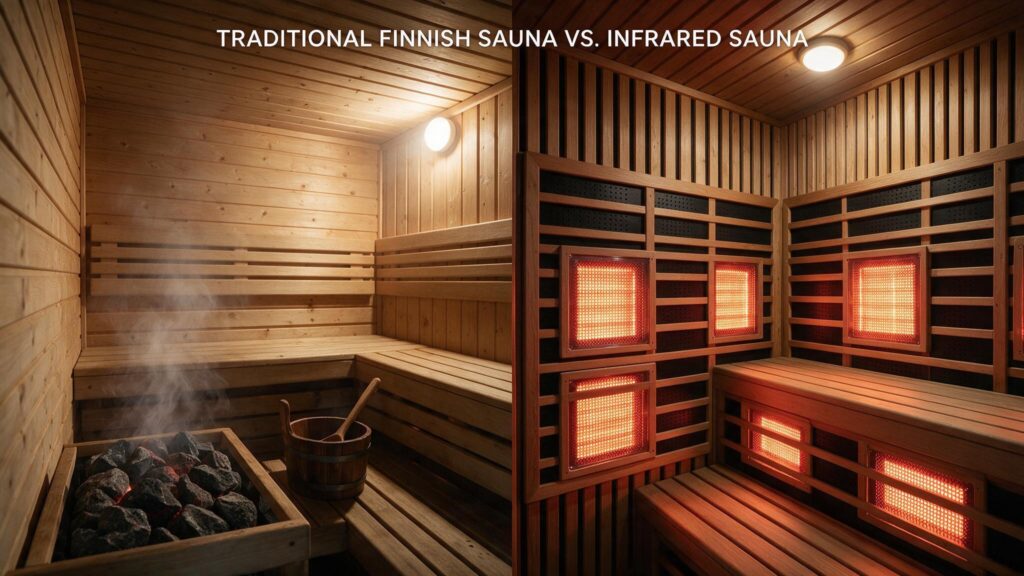
Traditional saunas have decades of research behind them; infrared saunas have only nine small studies, so the evidence gap matters.
The evidence gap
Traditional saunas have more scientific support. The KIHD prospective cohort study — a 15-year study of around 2,300 people in Finland — found that using a sauna 2-3 times per week was associated with a 25% lower risk of dying from heart disease. Using one 4-7 times per week? A 77% lower risk.
No comparable study exists for infrared saunas. None. The 9 small studies we’ve talked about are all we have.
As Health.com put it, most well-supported benefits come from heat exposure itself, not the specific sauna type. If you’re choosing based on evidence alone, traditional saunas win — but that’s because they’ve been studied for decades, not because infrared is inherently inferior. Still, a growing body of research has produced an infrared sauna cardiovascular health guide that may give you another reason to consider the newer option, and thoughtfully designed infrared saunas, low-EMF heaters, and medical‑grade water filtration can help create a calmer, cleaner home environment for better sleep.
Practical tradeoffs
Infrared saunas plug into standard 120-volt outlets. No special wiring, no contractor needed. Traditional saunas need a 220-volt heater or a wood stove — a bigger installation project, which is why SaunaCloud was named Best Infrared Sauna for 2026 on MSN.
Infrared saunas run cooler, so fire risk is lower. They fit 1-4 people, making them more intimate. Traditional saunas fit 6-10, better for groups or families.
The feel is different too. Traditional saunas have very low humidity — 5% to 15%, which creates that sharp, dry heat. Infrared saunas feel gentler. Dr. Young notes that this can be far more comfortable for users while still providing comparable benefits.
There’s also the cultural dimension. Saunas have been used in Nordic countries for 10,000 years, but according to Christopher Kiggins at SaunaCloud, a manufacturer of custom infrared saunas with integrated red light therapy, infrared saunas are a modern invention. That doesn’t make one better — but traditional saunas have a long track record that gives you confidence.
Safety, Risks, and Who Should Be Cautious
Here’s some good news: no harmful effects have been reported in any infrared sauna studies. That’s from the Mayo Clinic, the Cleveland Clinic, and the Beever review. Saunas in general have been around for thousands of years with a strong safety record.
The primary risk is dehydration. If you feel dizzy or nauseated, get out immediately. That’s non-negotiable.
You should avoid infrared saunas if you’re pregnant, have heart disease, have had a recent heart attack, are under the influence of alcohol or drugs, or take certain medications. Dr. Young recommends checking with your healthcare provider before starting if you have pre-existing conditions.
One concern worth noting: electromagnetic fields (EMF) from low-quality units. Research on EMF risks is limited and inconclusive — not something to lose sleep over, but worth knowing if you’re shopping for a sauna. Low-cost units from Alibaba are the classic example of quality concerns. Look for Canadian Standards Association approval or equivalent safety certifications.
Why the Evidence Is Weak: Study Limitations You Should Know
This section exists to give you context, not to dismiss the research entirely. But you should know what you’re working with.
The Beever review identified the same limitations across all 9 studies: small sample sizes, short durations, use of non-validated symptom scales, and many conducted by the same core research group. The review also classified each study as level I or level II evidence — level I includes randomized controlled trials, while level II covers cohort or observational studies, giving you a clearer picture of the strength behind each finding.
The numbers matter here. Sample sizes: 2 to 46 participants. Study durations: 14 to 35 days. That’s not enough to assess long-term effects or apply findings to the general population.
The same Japanese research group — Kihara, Miyamoto, Masuda, Sugahara, appears across multiple studies. That’s not a conspiracy, but it raises questions about reproducibility. Would another research group get the same results?
The core limitation isn’t that the evidence says “no benefit.” It’s that it says “we don’t know yet.” With infrared saunas, we’re mostly in the unproven category.
How to Use an Infrared Sauna Safely (And What to Expect)
If you decide to try an infrared sauna, here’s what works based on what we know.

Start with 10–15 minutes at 110°F, hydrate well, and don’t expect dramatic health changes — it’s a mild cardiovascular stimulus.
A typical session runs 15 to 30 minutes at 110°F–135°F. Start closer to 10-15 minutes at the lower end of that range and see how your body responds. Hydrate well before and after — dehydration is real and it’s the main risk.
Optimal frequency is unknown. You’ll hear 2-4 times per week recommended, but that’s not evidence-based. It’s a guess.
What should you expect? A pleasant warm experience that produces a mild cardiovascular response, similar to a moderate walk. You might feel relaxed afterward. You might sleep better. You might not notice much at all.
What you shouldn’t expect is significant weight loss, detoxification, or dramatic health changes. View it as a tool for relaxation and mild cardiovascular stimulus — not a cure, not a weight loss device, not a medical treatment.
There’s emerging research on heat exposure and brain health from people like Dr. Esther Blessing at NYU’s Grossman School of Medicine, published in the Journal of Alzheimer’s Disease. It’s interesting. It’s very preliminary. Keep an eye on it, but don’t buy a sauna based on it.
The Bottom Line
The Mayo Clinic’s “Perhaps” is the most honest summary of the evidence. Not a yes, not a no — an honest acknowledgment that we don’t know enough yet.
Here’s what is real: infrared saunas produce a physiological response similar to a moderate walk at a temperature most people find comfortable. That alone might be worth it for the relaxation and mild cardiovascular stimulus.
Here’s what is possible but unproven: cardiovascular benefits for heart failure and blood pressure, chronic pain relief. The strongest evidence in the pile, and it’s still limited.
Here’s what marketing claims you should be skeptical of: detoxification, weight loss, cholesterol reduction. The evidence either doesn’t support these claims or actively refutes them.
Here’s the most important takeaway: most well-supported benefits come from heat exposure itself, not from the infrared label. If you’re choosing between sauna types, traditional saunas have a much larger evidence base. But if infrared’s lower temperature and easier installation make it the option you’ll actually use, that counts for a lot.
They’re not a magic health device. They’re a pleasant way to get warm, sweat a little, and give your heart a mild workout. If that sounds good to you, and you buy a quality unit from a reputable manufacturer, you’ll probably enjoy it. Just don’t expect it to transform your health.
Frequently Asked Questions
Is there a downside to an infrared sauna?
The main downside is the weak evidence base — only 9 small studies support most health claims, so you’re buying into something that’s more promising than proven. Other trade-offs include the risk of dehydration, potential EMF exposure from low-quality units, and the fact that you won’t get the dramatic detox or weight loss results that marketing promises.
What type of sauna is healthiest?
Traditional saunas have a much larger evidence base, including a 15-year study showing a 77% lower risk of dying from heart disease with frequent use. Infrared saunas run at lower temperatures and feel gentler, but most well-supported benefits come from heat exposure itself, not the sauna type. If you’re choosing based on evidence alone, traditional saunas win — but infrared is a solid option if its lower heat and easier installation mean you’ll actually use it.
Is it okay to infrared sauna everyday?
No harmful effects have been reported in any infrared sauna studies, so daily use is likely safe for most people as long as you stay hydrated. The optimal frequency is unknown — the common recommendation of 2–4 times per week is a guess, not evidence-based. Start with shorter sessions at lower temperatures and listen to your body; if you feel dizzy or nauseated, get out immediately.
Do infrared saunas actually detoxify your body?
The research on detoxification is controversial and in its infancy — the most comprehensive review found no evidence to support claims that infrared saunas meaningfully remove heavy metals or toxins. While sweating does excrete some substances, whether that makes a real difference in your body’s total toxic burden is completely unknown and unstudied. Don’t let anyone sell you that leap.
What’s the difference between an infrared sauna and a traditional sauna?
Infrared saunas use light to heat your body directly without warming the air around you, running at 110°F–135°F, while traditional saunas heat the air with hot rocks or a stove to 150°F–195°F. Infrared saunas plug into standard outlets and feel gentler, making them more comfortable for people who find traditional saunas overwhelming. Traditional saunas have a much larger evidence base and a 10,000-year cultural track record.