
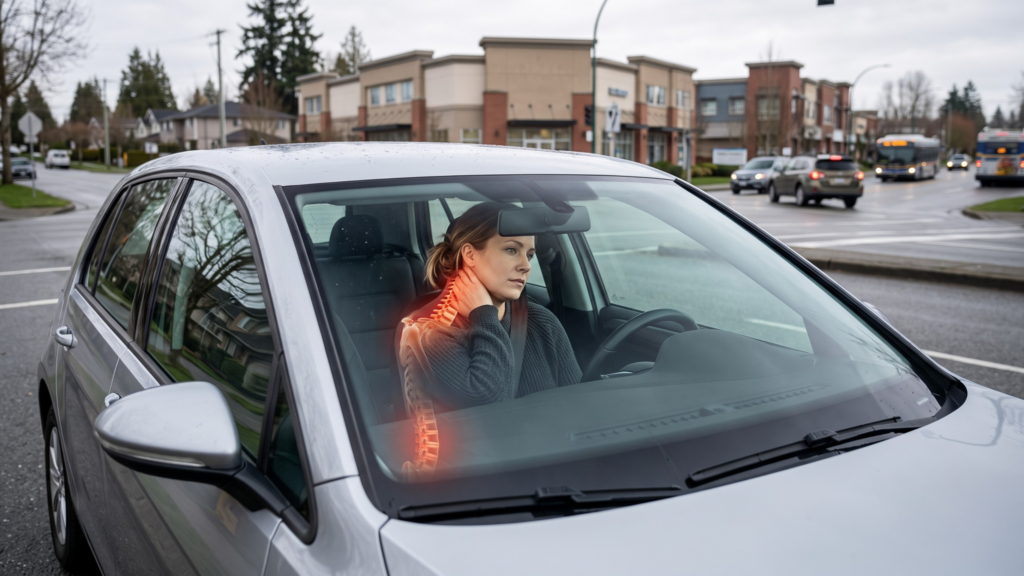
Car accidents often get discussed in terms of the impact itself, insurance paperwork, or vehicle damage. What receives less attention is the slower, less visible part of the story: the days and weeks after the collision, when stiffness sets in, headaches linger, sleep becomes lighter, and simple movement starts to feel unreliable. Many people walk away from a crash believing they are mostly fine, only to realize later that their neck hurts when driving, their back locks up after sitting, or their concentration slips because pain has become a constant background signal.
That pattern is common in growing suburban regions such as Langley, where driving is a routine part of work, school, errands, and family life. Langley’s location within Metro Vancouver places residents in regular traffic flow along routes tied to Highway 1, Fraser Highway, 200 Street, and the broader commuter network connecting Surrey, Abbotsford, and surrounding areas. The more time a population spends in vehicles, the more likely it is that collision related injuries, even lower speed ones, will remain a real public health concern. Across Canada, transport related injuries continue to generate a significant rehabilitation burden every year, and musculoskeletal pain remains one of the leading reasons people seek conservative care after non catastrophic trauma.
Recovery after a motor vehicle accident is rarely just about one painful body part. A person may feel neck tightness, shoulder restriction, rib discomfort, lower back pain, fatigue, and a subtle sense that their body no longer moves naturally. Some also develop nervous system symptoms such as poor sleep, hypervigilance, tension headaches, or anxiety during driving. That mix is one reason readers looking into ICBC physiotherapy Langley are often searching for more than coverage details. They want to understand how structured rehabilitation fits into actual recovery.
This matters because Canada continues to face a substantial burden from musculoskeletal disorders. National prevalence estimates have shown that more than one in four people experience musculoskeletal conditions in a given period, with the back, neck, and lower limbs among the most affected areas. At the same time, rehabilitation professions have expanded to meet growing demand, with more than 21,000 physiotherapists employed in direct patient care across Canada. Those numbers reflect a simple reality: pain and movement problems after injury are common, and recovery tends to improve when people receive timely, guided support rather than waiting passively for symptoms to disappear.
 Why Minor Crashes Can Create Major Disruption
Many post collision symptoms do not appear dramatic at first. Someone may notice only light stiffness on the day of the crash, then wake up the next morning with a neck that barely turns or a back that feels unstable. That delay happens because inflammation, muscle guarding, and nervous system sensitivity can build over time rather than peak immediately.
Soft tissue injuries often involve a chain reaction. The body braces during impact. Muscles tighten protectively. Breathing changes. Sleep is disturbed. Normal movement becomes cautious. Even if imaging shows nothing severe, the person may feel very different in their own body. This is especially true after rear end impacts, side collisions, or sudden braking events, where rapid force transfer can affect the neck, upper back, shoulders, ribs, and low back all at once.
In Langley, these problems can have a direct effect on daily function because the region depends heavily on driving. If turning the head hurts, school drop offs become stressful. If sitting aggravates the back, commuting becomes exhausting. If shoulder tension triggers headaches, screen based work becomes harder. Recovery is not just about symptom relief in the clinic. It is about returning to routine without pain dictating every decision.
The Overlap Between Pain, Stress, and Delayed Recovery
One of the most misunderstood parts of accident recovery is the role of stress. People often separate emotional strain from physical injury, but the two interact constantly after a crash. Even a relatively minor collision can leave a person tense, startled, and more guarded than usual. They may sleep lightly, brace during driving, or react strongly to normal aches because the body still feels on alert.
That matters because stress can amplify pain. It changes breathing patterns, increases muscle tone, and reduces recovery quality. A person with post collision neck pain may also be dealing with shallow breathing, jaw clenching, fatigue, and poor sleep, all of which can make symptoms feel more persistent. This does not make the pain less real. It explains why recovery can become more complex than a simple tissue injury.
For many people, the hardest part is not the first week. It is the period after that, when symptoms start interfering with ordinary life. The person is expected to resume work, care for family, drive around Willowbrook or Walnut Grove, manage errands, and keep life moving, even though their body still feels off. That is where structured support becomes valuable.
What Physiotherapy Adds to Post Collision Recovery
Physiotherapy can play a key role after an accident because it focuses on restoring movement, reducing pain, and rebuilding confidence in the body. A strong plan does not treat recovery as passive rest. It looks at how symptoms behave, what movements have become limited, what tissues are overloaded, and how to reintroduce activity without triggering repeated setbacks.
A physiotherapist will usually assess several factors at once:
- Neck and back range of motion
- Shoulder and rib mechanics
- Headache patterns
- Balance and dizziness if relevant
- Strength and movement tolerance
- How daily tasks such as sitting, lifting, walking, and driving are affected
This is important because collision injuries often create compensation patterns. If the neck is stiff, the shoulders may overwork. If the ribs are restricted, breathing may become shallow. If the low back feels threatened, the hips may stiffen and the person may stop moving normally. Good rehabilitation looks beyond one painful spot and tries to restore the whole system.
In practical terms, that may involve manual therapy, graded mobility work, targeted strengthening, postural retraining, breathing drills, and progressive return to activity. The best results usually come when care is individualized rather than formulaic.
Why Early Movement Often Works Better Than Prolonged Rest
Many people instinctively assume that rest is the safest response after a crash. Short term rest can help in the earliest phase, especially when pain is acute, but extended inactivity often creates new problems. Muscles become deconditioned, joints stiffen, circulation drops, and fear of movement grows.
This is one reason current rehabilitation thinking emphasizes guided movement rather than complete shutdown. People tend to recover better when they keep the body moving within tolerance. That might mean short walks, gentle mobility, breathing based unloading work, or controlled exercises that restore confidence without pushing into major flare ups.
For Langley residents, this approach matters because everyday function often depends on mobility. Walking through Fort Langley, navigating shopping areas near Willowbrook, driving to appointments, or managing school and work demands all require a body that can tolerate regular movement. Recovery needs to be practical, not theoretical.
Canadian health research has consistently shown that musculoskeletal recovery improves when people stay appropriately active. That does not mean ignoring pain or pushing through severe symptoms. It means using movement as medicine, with the right pacing and progression.
The Most Common Symptoms After a Motor Vehicle Accident
Post collision symptoms are often broader than people expect. Neck pain gets the most attention, but many patients experience a combination of issues that shift over time.
Common symptoms include:
- Neck stiffness and pain with turning
- Mid back tightness and rib discomfort
- Low back pain after sitting or driving
- Shoulder restriction
- Headaches that begin at the base of the skull
- Jaw tension
- Dizziness or lightheadedness
- Fatigue and poor sleep
- Anxiety during driving
Some symptoms appear immediately. Others emerge several days later. This delay can confuse people and make them question whether the crash really caused the problem. In many cases, the delayed pattern is normal. The body often becomes more symptomatic after the initial stress response settles.
Why a Whole Person Recovery Model Makes Sense
Accident recovery should not be framed as a narrow technical process. It affects physical function, emotional state, work capacity, and family life. A parent who cannot turn easily while reversing the car is dealing with more than neck pain. A tradesperson whose low back spasms after driving is dealing with more than soreness. A student who develops headaches and concentration issues after a collision is dealing with a disruption to daily performance.
That is why a whole person model is useful. It recognizes that recovery is not only about tissue healing. It is also about restoring confidence, sleep, strength, breathing patterns, and tolerance for normal life. That perspective fits well within a natural health and wellness conversation because it respects the body’s interconnected systems rather than isolating pain into one simple mechanical explanation.
This approach also leaves room for broader recovery habits that support formal care:
- Better sleep routines
- Gentle walking
- Reduced all day bracing
- Gradual return to daily tasks
- Heat or relaxation strategies when appropriate
- Consistent home exercise
None of these replace clinical rehabilitation when it is needed. They strengthen it.
What Langley Residents Should Look for in Recovery Support
Not every person needs the same pace or style of care. Someone with mild stiffness may improve quickly with a short course of support and home exercise. Someone with persistent headaches, back pain, or high driving anxiety may need a more gradual plan.
The key issue is whether the recovery path matches the person’s actual functional limits. Can they sit longer? Turn more easily? Sleep better? Return to work with less flare up? Walk without feeling guarded? Drive without bracing at every stoplight? These markers matter more than vague promises of feeling better soon.
In this context, physiotherapy should be judged by clarity and progression. A useful plan explains what the likely problem is, what changes should happen first, and how function will improve over time. Recovery feels less overwhelming when it is broken into practical milestones.
Returning to Daily Life Is the Real Goal
Most people do not care about recovery in abstract terms. They care about whether they can live normally again. They want to drive without fear, work without escalating pain, pick up children, sleep through the night, exercise, and move through the community without constantly thinking about injury.
That is the real purpose of structured rehabilitation. It is not simply to reduce discomfort in a treatment room. It is to help a person regain ordinary life after a disruptive event.
In a driving dependent region like Langley, that goal matters even more. Whether someone is heading through downtown Langley, commuting toward Surrey, or making family stops around local parks and shopping areas, recovery has to translate to the real world. The body needs enough trust, movement, and resilience to meet daily demands without constant symptom escalation.
Questions and Answers
How soon should someone start physiotherapy after a car accident?
Many people benefit from early assessment once acute medical concerns have been ruled out. Early support can help reduce stiffness, prevent compensation patterns, and guide safe movement before pain becomes more persistent.
Can a minor collision really cause lasting pain?
Yes. Even lower speed crashes can lead to neck strain, back pain, headaches, rib stiffness, and guarded movement. The injury may not look dramatic, but it can still affect function for weeks or longer if not managed well.
Is rest enough after a motor vehicle injury?
Short term rest may help in the earliest phase, but prolonged inactivity often slows recovery. Most people do better with guided, gradual movement that fits their symptom level.
What is the goal of physiotherapy after a crash?
The goal is to restore function. That includes reducing pain, improving mobility, rebuilding confidence, and helping the person return to driving, work, exercise, and daily activities more comfortably.