
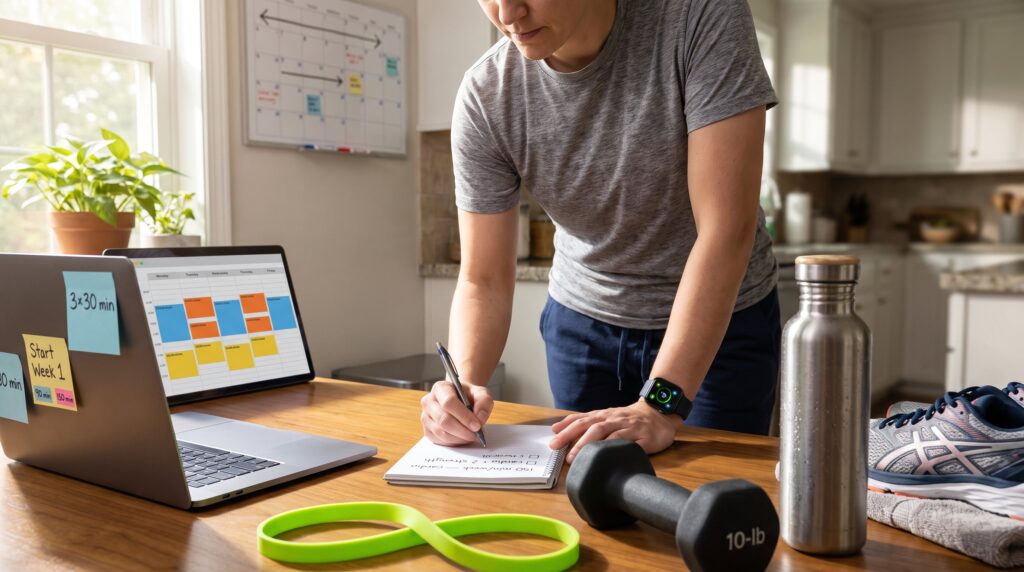
How to build a realistic weekly exercise routine starts with a clear reason and a small, measurable plan. Busy people often fail because they chase long workouts or vague goals. This guide gives a focused process: define purpose, measure baseline fitness, pick a weekly structure, design balanced sessions, follow a progressive four-week example for three time budgets, and lock habits that last. Each section gives concrete steps, quick examples, and honest trade-offs so readers can start within days and scale safely.
Key Takeaways
- Building a realistic weekly exercise routine starts by defining a clear why and assessing your baseline fitness to set measurable goals.
- Choose a weekly exercise structure—balancing strength, cardio, and mobility—that fits your available time and energy levels.
- Design balanced workouts incorporating compound strength moves twice weekly, steady-state or interval cardio, and daily mobility work to reduce injury and improve results.
- Progress your weekly exercise volume by about 10% each week, prioritizing consistency over intensity for lasting habit formation.
- Schedule workouts as fixed appointments and use small, repeatable cues to build habits that stick despite barriers like time or motivation.
- Adjust your routine when facing obstacles by reducing load, splitting sessions, or swapping modalities instead of quitting to maintain steady progress.
Define Your Why, Goals, And Baseline Fitness
Fact first: a clear why increases adherence. Busy people who name one specific outcome, improve heart health, lose 8 lb, squat bodyweight, stay more consistent. Start by writing one primary goal and one measurable target (for example: reach 150 minutes of moderate cardio per week within 10 weeks).
Assess baseline with three quick checks: weekly active minutes, a brisk 15-minute walk test, and any medical limits. Record current weekly active minutes for one week: that number sets the first load. If someone logs 40 minutes now, the goal to reach 150 minutes becomes a clear 10% weekly progression target instead of guesswork.
Set short milestones: 6-week, 12-week. Example: if the goal is strength, target two full-body strength sessions in week 1, then add intensity by week 4. For mobility goals, include 5–10 minutes daily and reassess range of motion at week 4.
Link: readers planning a broader wellness strategy can pair this approach with a helpful blog overview.
Pick Weekly Structure: Frequency, Duration, And Session Types
Answer: choose a structure that fits available days and energy. Common, realistic templates work well: 5×30 minutes moderate cardio plus two short strength sessions, or 3×25 minutes vigorous cardio with two strength days. Both meet public health targets when scaled correctly.
Practical step: map available time across the week. If someone has three 30-minute slots on weekdays, use two for cardio and one for mixed strength. If only evenings are free, split sessions into 15–20 minute bouts, three short bouts equal one longer session.
Session types to include each week: steady-state cardio (walking, cycling), strength (compound moves), and brief mobility work (5–10 minutes). The talk test is a simple intensity guide: if a person can speak full sentences, activity is moderate: if speech is limited, it’s vigorous.
Internal links: For help creating long-term plans, consult the article about sustainable fitness. For choosing the right personal routine, see the tips on finding right.
Design Balanced Workouts: Strength, Cardio, Mobility, And Recovery
Clear fact: balance reduces injury and delivers the broad benefits people want. Strength should occur at least twice weekly and hit major muscle groups. A practical prescription: 1–3 sets of 8–15 reps per exercise using a challenging load on strength days. Compound moves, squat, hinge, push, pull, give more return per minute.
Cardio choices depend on time and joints. Walking or cycling works for most: use intervals when time is tight (example: 10 minutes easy, 2 minutes harder × 3). Mobility can be 5–10 minutes daily, hip openers, thoracic rotations, and calf stretches that show immediate easing of stiffness within two weeks.
Recovery matters: schedule 1–2 lighter days weekly and avoid training the same muscles on consecutive days. If someone experiences persistent soreness for more than 72 hours, reduce load by ~20% or substitute low-impact cardio. Honest warning: pushing through sharp joint pain often lengthens downtime: scale intensity instead.
Internal link: For rebuilding after setbacks, readers can consult rebuilding routine.
Sample 4-Week Progressive Plan For Different Time Budgets
Direct answer: progress weekly volume by ≈10% and prioritize consistency over intensity. Below are three practical 4-week outlines.
90 minutes/week (busy schedule)
- Week 1: 3×30 min (2 brisk walks + 1 mixed circuit of 6 bodyweight moves)
- Week 2: add one 5-minute mobility routine after each walk
- Week 3: increase circuit difficulty by adding 1–2 reps per exercise
- Week 4: add a 10-minute interval set to one session
150 minutes/week (health guideline target)
- Week 1: 5×30 min moderate cardio + 2×20 min strength (full body)
- Week 2: replace one cardio with a HIIT 20-min session for intensity
- Week 3: add volume to strength sessions (2→3 sets) or add 5–10 min per cardio
- Week 4: test a moderate increase in total minutes (~10%)
Progress rules of thumb: increase total weekly volume by about 10% each week, prioritize sleep and protein on higher-load weeks, and schedule one lighter recovery day.
Internal links: The sample aligns with the site’s practical plan, view the 4-week outline at thehealthyprimate. For simple nutrition pairing, nutrition habits.
Schedule, Prioritize, And Build Habits That Stick
Immediate insight: habit beats willpower. Block workouts in the calendar like meetings and anchor them to daily routines (for example: walk after lunch or strength on Mon/Thu). Small, repeatable cues increase long-term adherence.
Tactics that work: use consistent days for strength (e.g., Monday and Thursday), track minutes and sessions in a simple app or notebook, and aim for two wins per week initially. If a day is missed, schedule a 10-minute recovery walk the same day to maintain momentum.
Honest moment: the author’s client missed three morning workouts in week 2: they switched to evening 15-minute sessions and regained habit in ten days. That adjustment preserved progress and reinforced belief.
Internal link: For motivation strategies, include insights from the site’s guide on regular exercise. For daily habit building, consult the building healthier.
Troubleshooting: Common Barriers And How To Adjust Your Plan
Straight answer: common barriers are time, energy, pain, and motivation. Practical fixes follow.
Lack of time: split sessions into short bouts (3×10 minutes), use commute walking, or swap one long session for two efficient HIIT blocks. Lack of energy: lower intensity or switch to mobility work that still counts as recovery while keeping the habit.
Injury or pain: choose low-impact options (pool, cycling), reduce load by 20–30%, and prioritize professional advice when pain persists. Skill gaps: follow beginner progressions, bodyweight to loaded movements, or choose machines that guide movement safely.
Cost concerns: bodyweight sessions at home require no equipment: a single resistance band costs under $20 and covers most strength progressions. Motivation dips: enforce tiny anchors (a 5-minute warmup) to break the inertia: celebrate micro-wins like consistent minutes logged for one week.
External link: For stepwise program starts and verified steps, the Mayo Clinic outlines five practical startup steps that complement these adjustments beginner steps.
Conclusion
Final takeaway: realistic routines begin with a clear why, a measured baseline, and a schedule the person can keep. Start small, prioritize strength twice weekly, include regular cardio and daily mobility, and progress by about 10% per week. When obstacles arise, adjust volume, swap modalities, or shorten sessions rather than quitting. For readers wanting broader context on health and nutrition that supports exercise, the site offers guides and plans to pair with this routine.